Saturday, May 3, 2014

Service on Wheels:  Nandini Mobile Van

In the last year, the Nandini Mobile Van has logged thousands of kilometers.  Educating rural citizens in the areas of sanitation, waste management, and public and personal health is the primary goal of the project.  Through the years, a strong emphasis has been placed on women’s empowerment and personal hygiene with children.  With 70% of Indians living in rural environments, there are literally thousands of villages to visit. 
Keeping this in mind, Nandini and its dedicated team of staff and volunteers have visited 17 villages in Gujarat for an average of 3-5 days each, wherein they engage with the local communities in innovative and creative ways of spreading the knowledge of responsible and safe sanitation and health management.  Many of these villages, after the Nandini visit, developed sanitation committees to address the longer term education and application of these learnings.  In this time, 8 villages have now been classified as model villages for sanitation based on the fact that 100% of homes in the village not only have toilets installed, but also utilize them. 
While spreading this awareness will always be the primary objective of the Nandini Van project, there have been many other discoveries and benefits in the last three years.  In this time, 56 domestic and international volunteers have accompanied the staff on these rural excursions.  During and after these visits, the volunteers are always amazed at the depth of the experience and the opportunity to immerse in these rich and colorful communities. The interactions and exchange of learning between families in these villages and volunteers from urban settings in Ahmedabad, other states in India, and from all over the world are a sight to behold.  The beauty of a project like the Nandini Mobile Van is how its benefits reveal themselves to us over time.

Water Is life & Sanitation is a way of Life.


Wednesday, March 12, 2014

Nandini Van Sanitation Awareness Camp
Lilapur village, Ahmedabad District
Date-8th to 10th January, 2014

Nandini Van sanitation camp was held at Lilapur village of Ahmedabad district in Gujarat. Lilapur is a small village with 165 houses and approx population figure is 900. There are about 300 buffaloes in the village which makes Milk business as a basic source of income for the villagers along with farming. There are 5 shops and 2 temporary shops (Gumti).
The village has a government school which has classes till std 8. The village has rich biodiversity. There is a very beautiful pond. The cattle force produces huge amount of dung daily, more than 1500kg and food waste is around 100 kg per day.
A three day camp was held in Leelapur Village in Ahmadabad together with NSS students under the guidance of shree Jayeshbhai, Director of ESI and Suresh Bhai and we also had the support of Dr. Anil Jain, Cardiologist who has his weekend home in Leelapur.
The three day camp was aimed to spread awareness about health and sanitation. Nandini, the transit bus that carries the team from village to village, and also displays pictorial banners and posters for awareness was taken to Leelapur.
The first day the team was introduced to the village Panchayat and the NSS team so as to understand the common agenda and develop a bond of understanding and collaboration. Also the whole team went around the village to have a look at the need and nuances of the village.
On the first day the camp was inaugurated in the august presence of Jayesh Bhai, where in the emphasis was laid on the need for toilets and cleanliness in the community and also at individual level.
The day was fully utilized by the team to become a part of the community to develop a family like enironment, girls from the team were made to stay and eat in the local community houses where as the men stayed with the NSS students with the same objective.
At night the NSS students performed street theatre to entertain the village folks and convey the message of cleanliness and risks associated with alcoholism and use of tobacco. The act was well appreciated and saw effective impact.
Day two began with Prabhat Pheris and morning exercise. Later the day was devoted for community cleaning. The team went around cleaning the streets, hand picking plastic waste painting wall slogans, donating dustbins, cutting nails and combing hair of the young children etc
Also, we could move the well off members of the community to donate 25 toilets to the toilet less families. The day ended with street theatre and movies showcased on cleanliness and healthy habits.
Also a highlight was a dummy death procession that was carried out and mourning songs were sung to arouse resistance against tobacco and alcohol.
The village bird feeder was cleaned and painted and it was said “earlier no one would even bother to look at the bird feeder, now it has become one of the most attractive buildings of the village and we can’t stop looking at it.”
The ripple effect of the activities of the camp were seen by each that took part.
The NSS students had a lot of vigour and zeal but it was felt through Manav Sadhna team’s intervention that how with introduction of silence and sarva dharma prayer a sense of patience and self-awareness was instilled among them.
Also within the community due to the group activities like wall painting and sports events for children, a new sense of togetherness was felt. By the close, the community too took part in the cleanliness drive and showed commitment towards a better cleaner community.

Day 1:
The camp was set up. An orientation function was organized in the village school and awareness for sanitation was spread among the folks.
The guest and the dignitaries took a round of the entire village and discussed about the issues of major concern related to the village.
Late evening, during the Gram sabha, short movies and videos were shown to the villagers to make them aware of various social issues.
NSS team organized a stage show to make people aware of the consequences of various social issues which prevailed in the village, they were-Rangala rangli drama, superstition, sanitation, addiction, difference between girl and boy, cleanliness.

Day 2:
Morning started with a great step to make the village residential area plastic free. The entire team of Nandini van and NSS showed their active participation in the movement.
Afternoon ESI team went for a survey of Sanitation facilities in the village and reports said that 65 houses did not have proper sanitation facilities.
Evening Grama Sabha was held again.  Topics of concern like stopping Child marriages, ill effects of drinking, rainwater harvesting, benefits of plantation and greenery were acted upon in the drama.
Spot mapping was done in the entire village.

Day 3:
Dustbins were made from oil cans and distributed in the village.
Slogans were painted at various spots in the village to spread awareness.
A discussion was held in village school where in members of ESI interacted with the children and discussed with them good living habits.
Survey of the toilet facilities of the entire village was done.

The issues related with Lilapur village are as follows:
1. Lack of sanitation facilities
2. A large part of the population is addicted to tobacco   and smoking which includes minor kids too.
3. Child marriages
4. Large amount of plastic waste, around 8.25kg per day
5. Inefficient use of Buffalo dung and food wastes
6. Spoiling the pond by opening a sewage pipeline into it
7. Garbage can provided by the Government is not cleaned up at regular basis which in turn has lead to disposal of wastes on the road side or open land.
8. High school is needed
9. Cutting of green wood for use as fuel
10. Cattle dung is not used for generation for bio gas, instead it is waste3d by letting it into open and later using it as manure. By that time, the manure will be mixed with plastic.


Wednesday, February 19, 2014

Paunar Mitra Milan

Vinobaji set up the Brahma Vidya Mandir Ashram, commonly known as the Paunar Ashram in 1959 for women to practice inner transformation. He spent the last 13 years of his life in this Ashram and initiated collective meditation practices and the practice of a self-sustainable life (Kaanchan Mukti). The Ashram is by the devotion and love of around 36 nuns.Vinobaji would often insist to celebrate his death anniversary instead of his birthdays.

Each year a 3-day gathering – Matri Milan, is organized in the same spirit around his death anniversary. The gathering hosts around 400 friends from all places who are aligned with the values of Vinoba and Gandhi. We were introduced to the
Paunar Ashram six years back by Gopal dada. This year we were given the opportunity to make the sanitation arrangements for this event. Gopal dada, a dozen volunteers and Sureshbhai marched in the space all charged with a deep sense of love and gratitude for this pure land. With the positive spirit of the volunteers we took the responsibility of the overall cleanliness of the campus and toilets; ambience with wisdom art; providing hot water for bathing etc. The volunteers worked day and night. They would jokingly say to the Gandhian elders to pardon their grown beard, as they did not have time to shave.It was a great spirit of service and our minds were sparked of with many ideas and we also got spaces to implement them.
The theme for this year was Maitri – friendship. We all volunteers were reflecting on the word – Maitri and thought that listening to each other’s stories deepens friendship. He suggested having everyone share in a circle rather than having few speakers. 400 powerhouses broke into 6 big groups forming giant circles. It was beautiful to hear each persons sharing. Powerful connections were built amongst people as everyone found out about everyone and deeper friendships were made.

Vinobaji would say to work from a mental makeup of Giftivism instead of activism. Sureshbhai set up a kindness table in the same spirit, where products were offered without a price tag and it was for the person to choose how much they wanted to offer from their heart. It was for the first time for most of the people to experience something like this. Everyone was so happy about the experiment and was received whole-heartedly. It was such a beautiful experience for the team to receive blessings from the Gandhian elders for this experiment in kindness. Not only people gave more than what we would have received if it had been only on a transaction basis but also friendships were established and so many beautiful stories were shared as the narrative changed.

Gopal dada was our constant inspiration through all these days. He was an 85 years young volunteer. Each day we would sit through circles for reflections and bring stories and values of Vinoba. He lived each day with the inspiration from Vinobaji. When someone asked him if he would want to go to the Vinoba Kutir he said that I don’t need to go there as Vinoba is in me. Gopal dada fell sick and was hospitalized. He was in constant prayers to god to delay his death by a day so that the Matri Milan gets over peacefully. He passed away on the next day early morning at 2 am. 

My self suresh had spent long years with Gopal dada’s fills his heart with so much gratitude and kindness just by his sublime remembrance.
My self sureh shared whenever he would think of Gopal dada’s sublime presence, his heart would be filled with so much kindness and gratitude. 

Monday, February 17, 2014

A Smile and An Act of Kindness a Day to Keep the Doctor Away

For approximately the last eight years, St. Xavier's Social Service Society has held an annual health-care fair to educate people on health and on disease prevention. My self suresh, a few staff members of the Environmental Sanitation Institute (ESI), along with a few of us volunteers came to spread messages not only sanitation and personal hygiene as a means of good health, but on the mental and spiritual aspect of well-being also. Thus, a gathering of a couple thousand people from all over Ahmedabad, during the course of two days allowed for many opportunities to share and connect over kindness and generosity! The ESI stall was set up on one side with it's usual demonstration equipment, various models on low cost toilets and educational posters. However, on day two of the fair, an impromptu gift-economy style kindness table was also laid out. This came about after Suresh-bhai the day before in his slightly feverish state of being- cooked up the idea to step it up the next day and really hone in one 'inner cleanliness' as well!

The kindness table was a bit hit, as people flocked in puzzlement to understand it and how it related to health. This included thirty plus volunteers at the fair who were students studying for their Masters in Social Work. First off in the early morning, Suresh-bhai explained the idea of the smile card and deck, and within minutes had all volunteers off to tag random participants, health-care educators and kitchen staff with small gift items and acts of kindness! Before doing so however, a moment of silence and prayer was held to start the days intention off right. A sight that had strangers holding hands within minutes of knowing each other and kindness blooming big.


Later on during the day, two men off in a corner were all smiles as the other was seemingly explaining the surprise random act of kindness he received. The gift- a small “Be the Change You Wish to See” flower lay, now hanging around his neck.

Small acts of kindness were spreading like wild fire across the fair and breaking even language barriers! Caruna and Zoe, (two inters visiting India from China), who were with us for a day, were lovingly nudged by Suresh-bhai to go give one of the students a hug. Zoe, who speaks very little english was asked to complete this 'kindness mission.” Initially in shock at the request, she then hesitantly went over the group of students and gave one of them a hug. Culturally very different for both Zoe and the student, but within minutes the entire group along with Zoe and Caruna were laughing and connecting over kindness!

At the end of the fair health, educators were asked to share a few thoughts from the day. In his closing remarks Suresh-bhai shared that when we connect with each other through kindness and generosity it is a process of self purification. Further that our mental and spiritual health is enlivened because through this connection we recognize ourselves as one with each other. So I leave you with this Rx: a smile and an act of kindness a day, will be sure to keep the doctor away!


Tribute to Gopal Dada

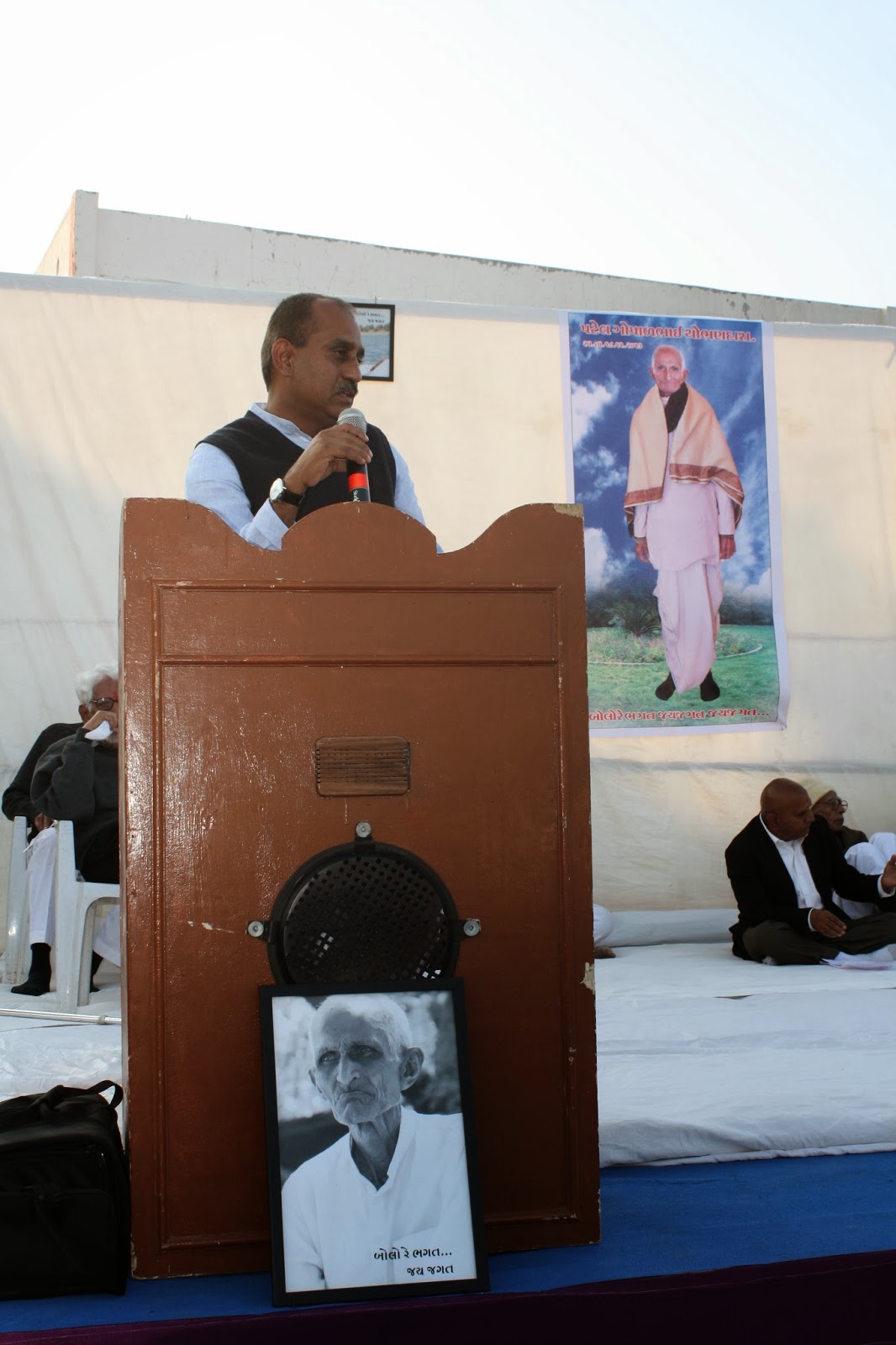
A Tribute to Gopal Dada a Devotee of Vinoba Bhave at the village of Unjha
January, 16th 2014

It was a remarkable day, for approximately four hundred people gathered, both friends and family, from near and far to honor the late Gopal dada in his birth town of Unjha just two months after his passing. Gopal dada, whose spirit and legacy still lives vibrantly in the hearts of all whom he touched. In this spirit, his disciples, whom he mentored and shared his values on Gandhian philosophy, and his life lessons, came together to share small stories that inspired them about their beloved Gopal dada. More than fifty of his personal disciples shared loving stories of inspiration. Many of these stories highlighted how Gopal dada was known for spreading kindness with small acts of love.

One such story was shared how he had created fifteen black boards all throughout the village. Before sunrise,with a lamp in hand, he would write positive messages and quotes for people to wake up to. Another story highlighted his spirit and devotion to nature. He planted more than five hundred trees in his home village and would with his own hands carry water from a nearby small lake and water these fragile trees with such care. Gopal dada was also a man of great integrity and honesty. Another shared how the people whom gave contributions with faith, to his revered cause and support of the Vinoba Ashram, were all returned with a receipt of their contribution.

This tribute was organized and sponsored by life long student of Gopal dada Ramji bhai. Ramji bhai whom finds deep gratitude for the lessons and values imparted by Gopal, shared that he never had the honor of meeting Vinoba Bhave, but that found his spirit in Gopal dada. He believed Gopal dada was the Vinoba of Unjha. He also in his honor, promised to lay down, for each of the trees planted Gopal, a seated area surrounding and encasing each tree.

Gopal dada, and the way with which he lived is life, was a great inspiration to many. Jayesh bhai, a long time friend, was particularly inspired by the way which Gopal dada lived a life of Sadhana- a life of great spiritual practice, and a life of simplicity. Among others that were inspired were Engineering students, from Stanford University in California, whom shared a reverence of his spirit. Particularly, a story that was recounted by Jeyesh bhai was that of which he was walking with Gopal dada on a road and saw him clearing the rocks away to the side of the road. In which Maria, a Stanford University student accompanying them asked him why he was doing this. Gopal dada proceeded to explain that in spirit of Maitri Bhav, noble friendship he is doing this. He may not know the person who may possibly walk behind him, but in doing this he may spare someone from hurting their feet on the small stones.

Among others the others who spoke about Gopal dada, there was also an individual who is known for singing great spiritual and devotional songs.  He sang with great might a personal favorite devotional song of Gopal dada.  It was with sang with so much heart and moved some to tears.
 
Gopal dada, whom by his legacy and with how he lived his life inspired and continues to inspire us, begs the question, how can we too, live a life with such purity and intention? His 'outer cleanliness' was a mere reflection of his inner purity. The small and in great ways with which he served has had a profound impact on many and continues to to this day.

Friday, January 17, 2014

Inspiring Kids to Be the Change

Inspiring Kids to Be the Change

Overview:

While parents and teachers do teach about the importance of adopting good sanitation and personal hygiene habits at home and in school, what you tend to find is that the method of teaching doesn’t include the underlying values, isn’t fun, and is given in an authoritarian style, all of which prevents the learning child from self-realizing the importance of the habits, which disinclines them from becoming ingrained, self-motivated behaviors.

It is specifically these areas we like to focus on in our awareness programs at primary schools. We have found that when you approach a child as an elder brother or sister and not an authority figure, make your activities fun, and frame the importance of sanitation and hygiene in the right context (e.g., that your body is like a temple and a gift from God, so how are you going to treat it it?) that you will inspire kids to make a change on their own.

Program at Vadasar, Moti bhoyan and Khatraj of Primary Schools:

In June, 2013 around seven karyakartas from ESI conducted a full day’s worth of programs at the Vadasar, Moti bhoyan and Khatraj Primary Schools located in the block area of Kalol in Gandhinagar district, Gujarat.

It was an inspiring and energetic day, which resulted in all the kids from the different classes taking a heartfelt pledge to keep their nails trimmed, comb hair and brush teeth daily, and always wash hands after going to the bathroom.

One to two karyakartas were assigned to each class and spent the entire day sharing with the kids. The program always starts with prayer and rapport building. Again, we want to set the right context for the importance of sanitation and hygiene. That there is a spiritual component involved, and that we are sharing the information out of love and respect for humanity and Nature. We are not parents or teachers, but servants in the Gandhian tradition of world harmony, genuinely interested in the welfare of kids and their community.

We use a number of values-based activities to help support the learning, such as fun songs, inspirational videos, drama skits, and games. We also use charts of all the various practices like nail cutting, teeth brushing, and hair combing and give live hands on demonstrations of them—these demonstrations, especially, the kids enjoy.

At ESI, we like to make dustbins out of old oil tins. We paint them with a sanitation slogan and creative images, which makes them more fun to use, which increases the likelihood that they will be used. A few of these bins were donated to the school.

All of us were moved deeply by the kids’ enthusiasm and commitment to improve their practice of sanitation and hygiene. In addition to the personal pledge they took, the kids all decided to share the values they learned forward throughout their community.


MSW student visit at ESI campus

Students of MSW, II year from Bhavangarh came to ESI for their annual exposure visit on 5th January 2013. There were 105 students and 5 faculty members in all.

They were seated in the Maytri Hall where in the Vision and Mission of ESI, Safai Vidalya and Manav Sadhna was shared by Subhash Bhai. Also was communicated to them the ideals of a good social worker with reference to the book Hind Swaraj and otherwise. To work with the community rather for them. The key to become a true social worker is to work with true love and compassion. To focus not just on “pravriti” but on “anuvriti.” (Not just activity but also the emotions behind them.) And also to burn your ego, burn your I to open your eyes to the true world. And the most important mantra is to connect with the grassroots. Build a strong bond, true in service only then an effective transformation can happen.
Jayesh Bhai also addressed the group; passing to them the gospels of true service are indispensably connected to spirituality. It is only through the change in you that you can bring the required transformation in the outside world. Also one must understand the concept of Jai Jagat, wherein we see the whole world as our own master and we pray to thee. Giving examples of Nipun Bhai, Pacho, Lavanya, Phd from USA and Sanchi, who work for the cause of the sex workers Jayesh Bhai build up the student’s enthusiasm and gave them the much needed courage to keep going and mot give up!
After the tea break, Sureshbhai introduced the concept of giftivism (servicespace)by giving away smile decks and smile cards to the students, the ripples were such that the students themselves committed to apply the smile cards in the next 9 days in the field.  The ripples were seen such a student came up to say “It shook my world today! Changed the way I perceived love for myself and my fellow beings.